
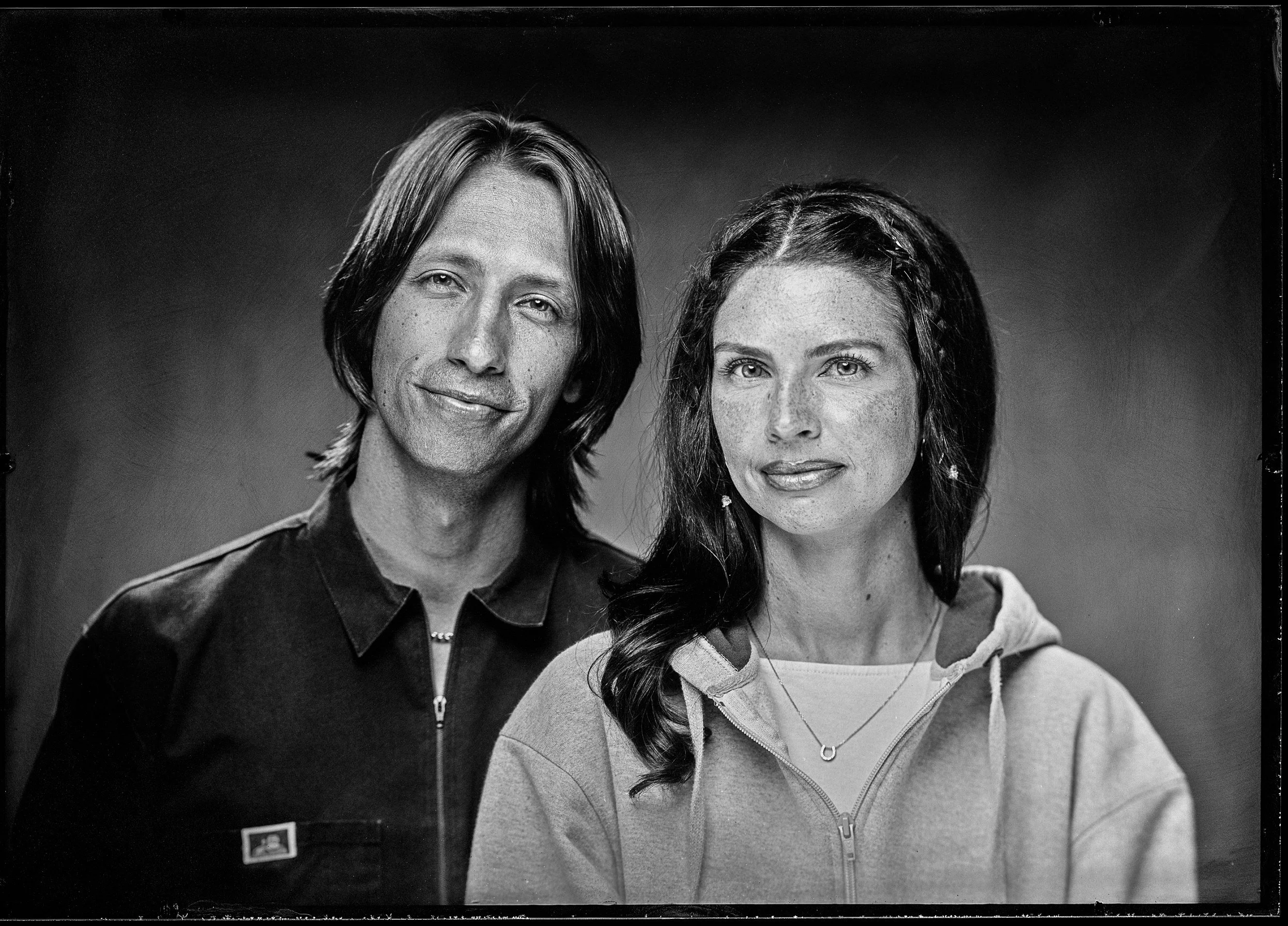
Preparing is simpler than people expect. Come to sit still as the person you intend to be.
Questions About a Salt Lake City Tintype Session
About Tintypes
Is it “tintype” or “tin type” — and is it really tin?
Both spellings turn up and I answer to either. Tintype is the usual one; plenty of people write tin type as two words, and in older books you’ll find ferrotype. They all mean the same photograph.
There is no tin in it. The plate is blackened aluminium — in the 1800s it was thin sheet iron — and “tin” was period slang for cheap metal that stuck to the name and never left. What actually makes it a tintype is the wet plate collodion process, not the metal: I pour collodion onto the plate by hand, sensitise it in silver nitrate, and expose and develop it while it is still wet. About ten minutes from pour to finished photograph, and what comes out of the camera is the photograph — there is no negative and no file behind it.
Booking
How far in advance can I book, and what's your availability like?
My booking calendar opens 90 days out. As a single parent, I schedule sessions around my child's schedule — plus dedicated time for pre-production (chemistry prep, darkroom cleaning) and post-production (scanning, varnishing, shipping) on every tintype. If you have a date in mind, book early.
Can I reschedule or cancel my session?
Rescheduling is allowed with at least 24 hours' notice — you'll find a reschedule link in your booking confirmation email. Your deposit moves with your booking, so you won't pay it again. You can cancel at any time, but deposits are non-refundable. All bookings are made through the Pricing page.
Do you offer gift certificates?
Yes. Here is what a gift certificate covers — the sitting, the plate, and how it reaches them. When you are ready, buy one here and it can be mailed directly.
Can I learn to make tintypes myself?
Yes. The 4-hour tintype workshop ($500) is one on one at the studio: you make, shoot and develop your own plates with my full attention, and we cover scanning and varnishing too. No previous photography experience is needed.
If you would rather start with a conversation, a video consultation over Zoom covers the wet plate collodion process around the topics you pick: $75 for one hour, or $125 for two.
What payment methods do you accept?
Cash, Venmo, and credit/debit card.
What should I expect?
I offer two kinds of sessions:
Private Studio Sessions — Longer, with the room to curate, stage, light and compose a scene. Plan for 1.5 to 3 hours, depending on how many plates we make. Sometimes we'll need to shoot a test plate first.
Open Studio Days & Pop-ups (not currently scheduled — watch for dates) — Discounted rate, short sittings — 20 minutes for a single plate, an hour for the triptych. Lighting and poses are more limited by the clock — on these days I am making 30–60 tintypes, so please arrive on time.
Every tintype is made by hand and takes about 10 minutes to pour, shoot and develop. Your session will involve a quick chat about the portrait we're making, posing (I'll direct you), a brief intense flash for the exposure, and then a trip to the darkroom to watch your tintype develop right in front of you. Ask as many questions and take as many photos and videos as you like.
Is it possible to do just one tintype?
Private studio sessions have a 3-tintype minimum. Setting up the plate, camera and darkroom takes the same time whether we make one plate or five, so the minimum is what makes that setup worth doing. If a single portrait is what you're after, keep an eye out for Open Studio Days, which occasionally offer a Single Tintype option.
Can I split a session with friends or family?
Yes — a single plate fits up to four in the frame, people and pets combined.
Preparing for Your Session
What should I wear?
- Glasses often photograph as sunglasses — contacts can tint your eyes a darker shade, wear at your discretion.
- Avoid large lettering/graphics on clothing — the image is mirrored and text can be distracting.
- All-black or all-white won't show up well on their own, but look great used sparingly.
- Chunky textures and patterns work well since much of the frame will be out of focus.
- Necklines are a nice detail to build around — layered or flowy fabric is a good option.
- Most importantly: dress how you want to represent yourself in the image.
Hair & makeup tips
- Avoid foundation — it can appear much lighter than your actual skin tone on tintype.
- Hats are welcome — we can work with any size or style.
- Less is more with jewelry and makeup — think of the look as a whole, not itemized pieces.
- Too much hair around the face/neck can cast dark, high-contrast shadows.
- Updos are my personal favorite and photograph beautifully on tintype.
- Hair & makeup artists can be arranged for longer sessions — message me for stylist recommendations and pricing.
Pose & expression tips
- You'll need to hold still for a few moments, so favor stable poses over dynamic ones.
- Know your angles — which side of your face, and from what height, do you prefer?
- Think about the character or identity you want to portray.
- It's usually an upper-body portrait, so don't stress about shoes or pants.
- Hands can be fun, but hand-modeling is harder than it looks.
- Most importantly: be deliberate about your expression. Gaze into the lens (or wherever you choose to look) and hold it. Smiles are nice but can look strained if held too long.
Where is your studio?
My studio is at THE GALA, 412 S 700 W, Ste 120, Salt Lake City, UT 84104. Use GPS — it's tucked between the interstate and the train tracks, and routes can be quirky. Park in the gravel lot behind the building near the patio and big windows. Enter through the grey door with the big “G” (GALA), then head to the back of the space to the window marked “TINTYPE PORTRAITS.”
Getting Your Tintype
How do I get my tintype?
Every tintype is scanned and then varnished for archival preservation, which takes about a week. I'll ship it directly to you — no need to arrange pickup. Allow 1–2 weeks from your session to it arriving. If you bought digital files, those are worked on alongside the plate rather than after it, so both land inside that same window — see the digital files answer below.
International shipping is also available — just email me to arrange.
How do I display and frame my tintype?
Tintypes use a black metal base for the dark tones and pure silver for the bright and mid tones — without enough light they can look dim, so hang yours somewhere bright. Track lighting aimed down at the piece is ideal.
Framing notes:
- Don't let the tintype touch glass directly.
- A shadow box looks best.
- A thick mat in a mid-to-dark tone (grey, forest green, deep red are my favorites) really punctuates the image — avoid anything brighter than the tintype itself.
- I'm working on sourcing custom frames designed specifically for tintypes, hoping to have them for sale later this year.
What are digital files, and which resolution should I choose?
Tintypes are hard to photograph well — the surface is metal and it reflects — so I scan each one before varnishing, while the surface is at its cleanest.
Ultra High Resolution (recommended) — thoroughly dust-removed and edited, for large prints and for archiving. Includes a 100MP TIFF scan, a JPG or PNG sized for social, a darkroom development video, and any behind-the-scenes footage from your session.
Standard Resolution — sized for phones and tablets, light dust removal only, and it will not print well at any size. Includes a JPG or PNG sized for social.
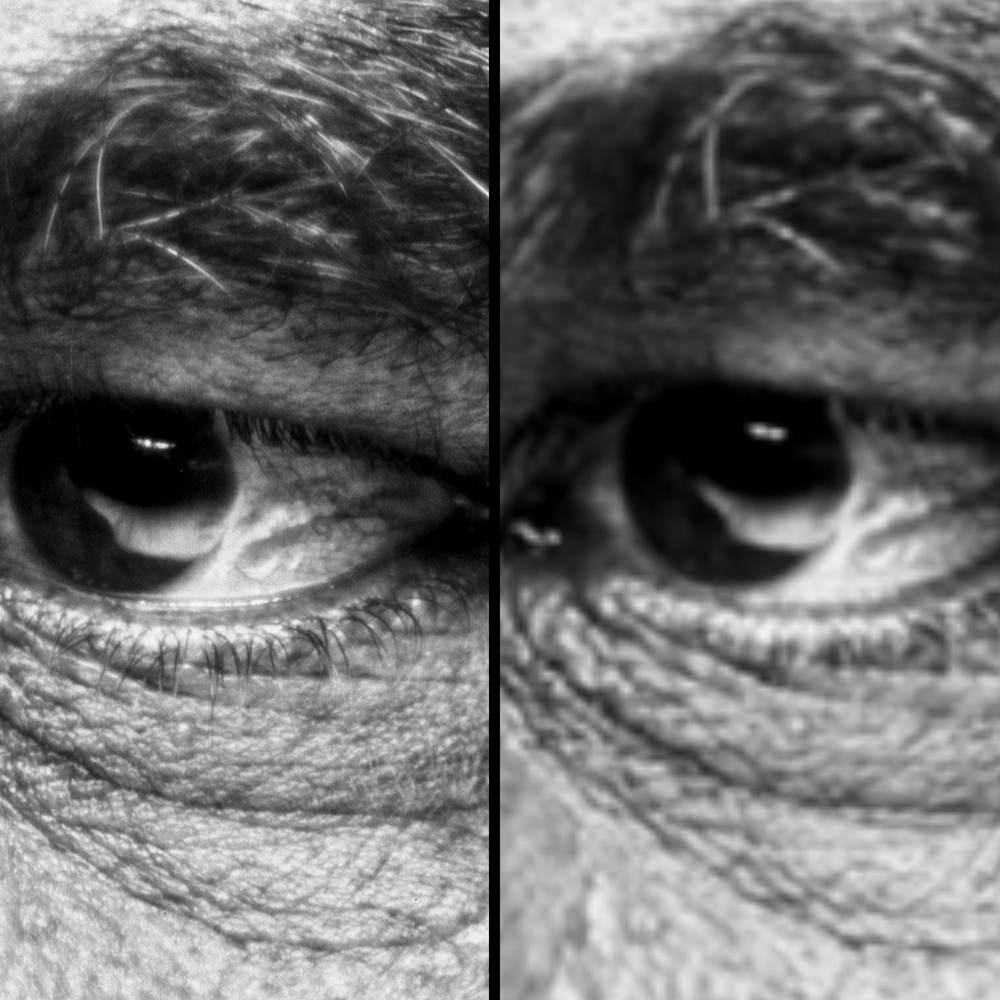
Scanning and editing takes about a week, and it runs alongside the varnishing rather than waiting for it. Files are emailed within 1–2 weeks as a Google Drive link you download from — a separate delivery from the tintype, not a later one. I've also digitally archived most past sessions, so email me if you'd like files from a previous shoot.
What if I don't like it?
Tintype is a historic, handmade medium and it is unpredictable — I do my best to get a great shot in the time we have. Ruined plates are reshot free; any other reshoot is half price.
Can I use my files commercially?
Digital files are licensed for personal use only. Email me about commercial licensing and pricing.